Gastvortrag: Ausgrabungen in Tel Hazor
05.02.2026Informativer und spannender Gastvortrag von Igor Kreimerman (Hebrew University) und Erik Eynikel (KU Eichstätt) am 30.01.
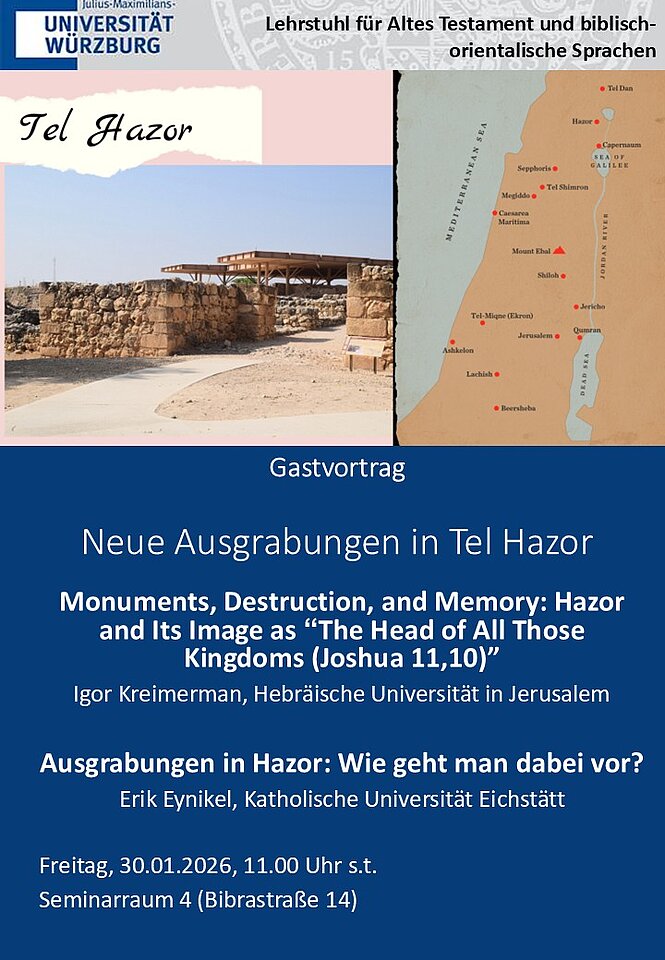
Hazor stellt als eine der bedeutendsten Städte der südlichen Levante in der mittleren und späten Bronzezeit eine bedeutende archäologische Ausgrabungsstätte dar. Igor Kreimerman (Hebrew University), der gemeinsam mit Erik Eynikel (KU Eichstätt) die Ausgrabungen in Hazor leitet, gab den interessierten Zuhörer:innen aus Theologie und Altertumswissenschaften Einblick in den Stand der archäologischen Forschung, die Zerstörung der Stadt im 13. Jh. v. Chr. und die spätere Erinnerung an Hazor, das nach Jos 11,10 "früher die Oberherrschaft über alle diese Königreiche" innehatte. Kenntnisreich, engagiert und abwägend führte er mit einer Fülle von Bildmaterial durch die archäologischen Entdeckungen und präsentierte Vorschläge zu deren Deutung im Kontext der Krise der bronzezeitlichen Stadtkultur im 13. Jh.
Im Anschluss gab Erik Eynikel praktische Informationen über die Ausgrabungen, die im nächsten Sommer in Hazor stattfinden werden, so etwa zum täglichen Arbeitsplan, erforderlichen Ausrüstung, Wochenendprogramm sowie der Studienreise. Eine Anmeldung hierzu ist - auch für Studierende - weiterhin möglich.
Vortragsinformation Monuments, Destruction, and Memory: Hazor and Its Image as “The Head of All Those Kingdoms (Joshua 11,10)” (Igor Kreimerman)
During the Middle and Late Bronze Ages, Hazor was the largest city in the Southern Levant. Extending over nearly 80 hectares and housing an estimated population of some 15,000 inhabitants, Hazor far exceeded its contemporaries in scale and political importance, fitting well the biblical description of the city as “the head of all those kingdoms” (Joshua 11:10). Archaeological and textual evidence place Hazor at the heart of far-reaching networks linking Egypt, the Northern Levant, and Mesopotamia.
Excavations conducted by the Hebrew University of Jerusalem have uncovered an exceptionally rich urban fabric, including monumental temples, palaces, administrative buildings, and extensive domestic quarters, allowing a detailed reconstruction of the city’s social, political, and ceremonial life. At the end of the thirteenth century BCE, this flourishing city was violently destroyed by a massive fire. The destruction appears highly selective: palatial and cultic buildings were burned, symbols of power were deliberately targeted, and statues were intentionally smashed.
This lecture situates the destruction of Late Bronze Age Hazor within the broader political collapse of the Eastern Mediterranean and compares the archaeological evidence with the biblical account of Joshua’s conquest. It concludes by arguing that when an Israelite city later rose atop the ruins, certain remains were treated in distinctive ways, suggesting that memories of the great Bronze Age city endured long after its fall.